PEAKDEFENCEWINGMAN · Security and complianceSee worked examples

WINGMAN by Peak Defence

The persistent security brain behind your AI assistants

WINGMAN keeps what your organisation knows about its security and compliance as one linked, current record. Claude, ChatGPT and other AI assistants work on that record: they run improvement projects, keep routine work on schedule and prepare the next step when an incident or a vulnerability arrives. AI proposes and people decide.

An AI assistant alone

Every chat starts from pasted context and forgets it afterwards. Nothing records who decided what.

Separate registers

A risk register, a control matrix, an asset list, an audit tracker. Each copies a little of the others and drifts apart.

With WINGMAN

Every record exists once and is linked to the rest. Assistants read it and propose changes, a named person accepts each one, and the record stays current because all the work runs on it.

In one picture

How WINGMAN works

The same four steps, whether you sit on the board, run engineering or audit the result.

  1. 1

    Something happens

    A new requirement, a review that is due, a scanner finding, an incident.

  2. 2

    Your assistant prepares

    It reads the linked record and drafts what should change: a risk rating, a report, a task.

  3. 3

    A person decides

    A named person accepts or rejects each suggestion. Nothing changes until then.

  4. 4

    The record remembers

    Who decided what, and when, stays in the history, which cannot be edited or deleted.

The next time something happens, the work starts from that record, not from a blank page.

Where you are

Which of these is your situation?

Security governance looks different depending on who has to carry it. Pick the one closest to you.

A customer asks for ISO 27001, and we have no security team

Start from the requirements and from what you already run. Your AI assistant drafts the scope, risks, controls and policies with you, one step at a time, and you confirm each one.

Starting from zero →

I am accountable for security and cannot judge where we stand

A management review prepared from the records shows what changed, what is overdue and what needs your decision. Your approvals are kept with their dates.

For the board and CEO →

I look after security alone, next to another job

Reviews come round by calendar, not by memory. Reports for the regulator are prepared from the records, not written from nothing each time.

For public bodies and one-person security functions →

Our registers drift apart, and much of the programme is in my head

Every record exists once and belongs to a role, so the programme survives a change of staff. A check across all records lists what has drifted, such as a risk with no control or a control with no valid evidence.

For CISOs and security leads →

We are certified, but the risk register only moves before an audit

Scanner findings and supplier notices arrive as signals, linked to the assets and risks they touch. Your assistant proposes the rating change with its reasoning, and a named person accepts it.

For CISOs and security leads →

I audit, and every statement must trace to its evidence

You get the claimed controls with paragraph references before fieldwork. Finding, evidence and conclusion stay linked, and the auditor confirms or changes each finding.

What an auditor sees →

I run security programmes for several organisations

Run the same procedure, such as a risk interview, a business impact analysis or an audit, from your AI assistant against each organisation's own record.

For consultants and vCISOs →

In the product

What it looks like

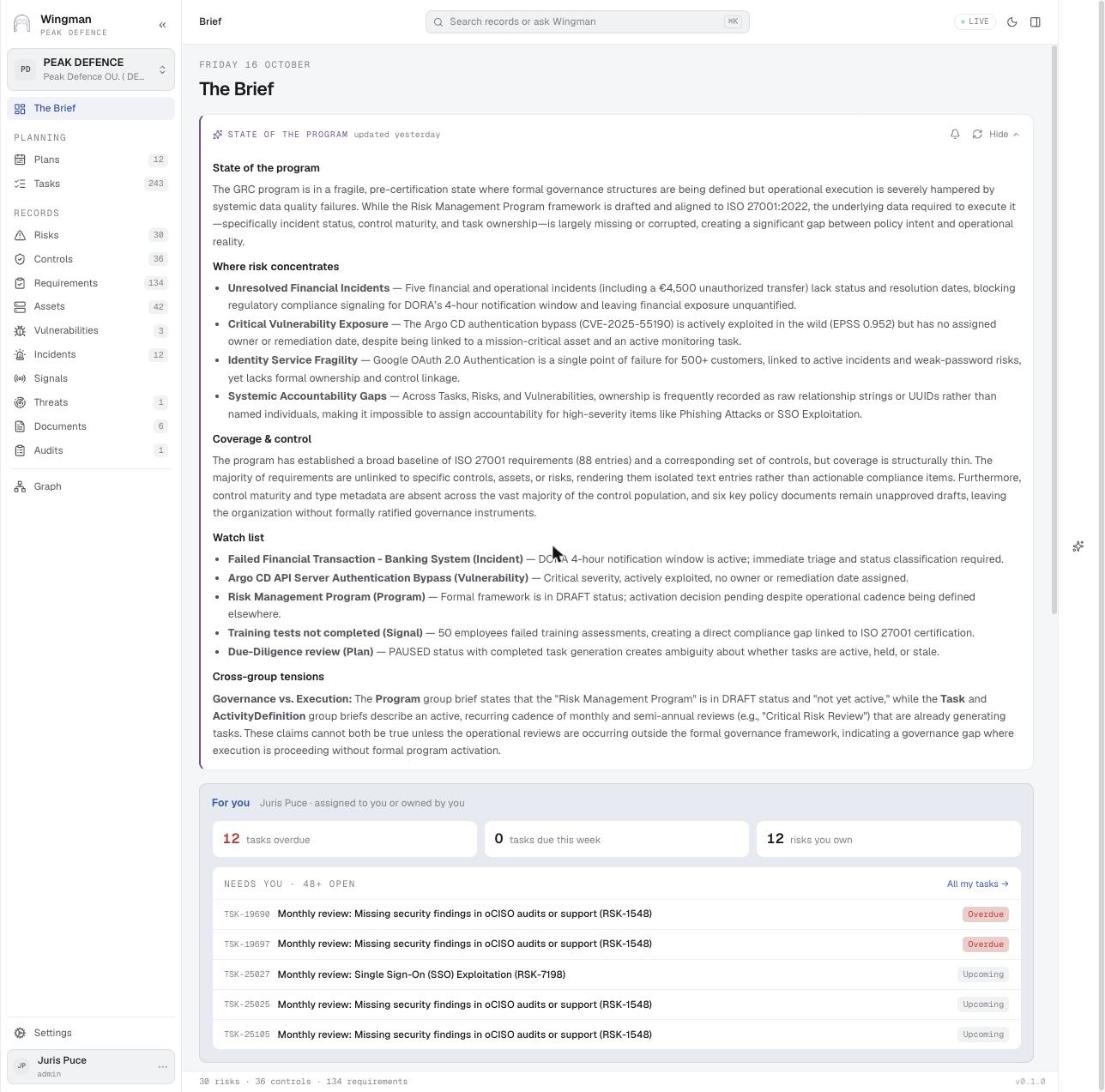
The morning Brief, written by WINGMAN's AI from the records, and a short video of the model behind it.

The Brief: state of the programme
The Brief The Brief: state of the programme Every morning WINGMAN writes the state of the programme from the records: where risk concentrates, coverage and control, a watch list and the tensions between groups of records.
WINGMAN AI GRC data model How risks, controls, assets and suppliers connect in one model, kept current in WINGMAN or through MCP with AI assistants.

Plays from youtube-nocookie.com. YouTube sets no cookies until you press play.

What WINGMAN does

One record, and four kinds of work on it

AI assistants connect to WINGMAN over MCP, an open standard for giving assistants access to tools and data. A skill is a procedure the assistant follows step by step on your records.

  1. Keeps your security knowledge current

    Requirements, assets, risks, controls, suppliers, roles and evidence are linked records, each stored once. Every project, review and incident updates the same records, so your assistant answers from the current state, not from whatever was pasted into the chat.

  2. Runs implementation and improvement projects

    Skills take you through a new standard, a risk interview, a business impact analysis or an internal audit. Planning a framework implementation, from scope to tasks for each person and the policies they follow, takes days instead of months. The assistant reads the record and proposes changes; you accept them.

  3. Keeps routine work on schedule

    Reviews of risks, policies, suppliers and access follow a calendar. Owners get reminders, evidence shows when it is about to expire, and the management review is assembled from the records.

  4. Prepares the response to what was not planned

    A scanner result, a supplier notice or threat news arrives as a signal. WINGMAN shows which assets and risks it touches and proposes the next step, including drafts of the reports that have deadlines. People decide and act.

What you can ask

Questions the record answers

Because records are linked, an answer is a path from one record to the next, not a search through folders.

A key supplier fails. What is hit, and what protects us?

From the supplier to the services it provides and everything that depends on them, to the risks on those services, to the controls that reduce them.

Can we prove this ISO 27001 clause today?

From the clause to the controls that meet it, to their evidence. Expired evidence shows up as a gap before the auditor finds it.

Our CISO has left. Who owns her controls and risks now?

Ownership sits on the role, not the person. Assign the role to the successor and every record follows.

Which risks did this incident make real?

From the incident to the affected assets and the realised risks, up to the enterprise risk they roll into, to the controls that should have held and the follow-up tasks.

New threat news. Does it concern us?

From the signal to the threat, to the weaknesses it exploits, to the assets carrying them and the risks they raise.

Is last year's audit finding closed?

From the audit to the finding, to the corrective task and the evidence it was done, to the conclusion on the clause.

Follow these paths on the graph →

A missing link is a finding

WINGMAN checks every record for these patterns and lists each one with its owner and a link.

See the gaps on the graph →

Sectors and regulations

The same model, read through your regulation

Each page takes one regulatory regime and shows which registers WINGMAN keeps for it, how the governance cycle runs on the graph, and what the use cases look like from that angle.

NIS2 and national cybersecurity law

Run the information security office of an essential or important entity from one registry of suppliers, assets, risks, incidents, vulnerabilities, threats and tasks.

NIS2 (EU) 2022/2555 · Nacionālās kiberdrošības likums · MK noteikumi Nr. 397 · ISO 27001

Financial sector – DORA, MiCA and supervisory expectations

Run operational, financial, reputational and other non-financial risk management on one model, and catch the events that should move it.

DORA (EU) 2022/2554 · MiCA (EU) 2023/1114 · ECB / SSM supervisory expectations · EBA guidelines on internal governance and outsourcing

ISO 27001 and SOC 2 Type 2

Keep the whole ISMS in one model, with control ownership, recurring reviews, management review and evidence that holds up over an audit period.

ISO/IEC 27001:2022 · ISO/IEC 27002:2022 · SOC 2 Trust Services Criteria · ISO 27001 Annex A

AI governance – ISO 42001, EN 18286 and the EU AI Act

Treat each AI use case as an asset with its own risks, controls and work plan, and show conformity with the EU AI Act from the same records.

ISO/IEC 42001:2023 · EN 18286:2026 · EU AI Act (EU) 2024/1689 · ISO/IEC 23894

Cyber Resilience Act

Design CRA compliance into how products are built and supported, from risk assessment and SBOM to vulnerability handling and reporting.

CRA (EU) 2024/2847 · CRA Annex I essential requirements · ISO/IEC 27001 · IEC 62443-4-1

GDPR and data protection

Keep the record of processing, DPIAs, processors, data subject requests and breaches as linked records, so accountability can be shown at any time.

GDPR (EU) 2016/679 · Personal Data Processing Law (Latvia) · ISO/IEC 27701 · ISO 27001

Videos

See it in motion

Short explainers of the model and of individual use cases.

WINGMAN AI GRC data model How risks, controls, assets and suppliers connect in one model, kept current in WINGMAN or through MCP with AI assistants.
WINGMAN AI GRC – audit use case An audit step by step, from claimed controls in documents to findings, the report and the fix plan back in WINGMAN.
WINGMAN AI GRC – risk management use case Regular risk reviews and new risk identification, plus incidents, signals and vulnerability changes between reviews.
WINGMAN AI GRC – financial sector (DORA, MiCA, ECB) Live signals on critical functions, ICT and supply-chain risk, major incidents decided by people, and supervisor reports drafted for submission.
ISMS implementation with WINGMAN AI Building an information security management system in WINGMAN, from requirements and scope to risks, controls, owners and the review cycle.
WINGMAN AI GRC – supplier assessment automation Automating supplier assessment with WINGMAN AI, from registering the supplier to the evaluation, the decision and ongoing monitoring.
Running a regular ISMS management review with WINGMAN AI Preparing and running the management review from live records, and turning its decisions into tracked tasks.
EU AI Act compliance with WINGMAN, including ISO/IEC 42001 and EN 18286 Meeting the EU AI Act with WINGMAN, with ISO/IEC 42001 and EN 18286 covered by the same AI use cases, risks and controls.

Plays from youtube-nocookie.com. YouTube sets no cookies until you press play.

Worked example

See what the records add up to

Outputs from fictional organisations: the first three days of an ISO 27001 implementation, a management review pack, one audit requirement traced to its conclusion, one risk change with its history, a consultant's monthly report, and the structure of a Latvian self-assessment report and CERT.LV incident reports.

Worked example

ISO 27001 from zero, the first three days

A 60-person software company with no security team runs the implementation skill on WINGMAN. What the first three days produce, who does what afterwards, and what still takes calendar time.

For: teams starting from zero · consultants and vCISOs

Worked example

A quarterly management review pack

What the management body receives before a quarterly review, and what is recorded after it. Every line comes from a record that can be opened.

For: board and CEO · CISOs and security leads · auditors

Worked example

One audit requirement, from claim to conclusion

How a single requirement is traced in an internal audit, from the document that claims the control to the conclusion, the correction and the check that the fix worked.

For: auditors · CISOs and security leads

Worked example

One risk change, from signal to history

A vulnerability that is being exploited moves a risk rating. This sample shows the signal, the containment, the suggestion the AI raised, the person who accepted it, the treatment, and what the history keeps.

For: CISOs and security leads · auditors

Worked example

A consultant's monthly client report

A month of work for one client, with what the consultant did, what the client's people did, progress against the target, and the decisions waiting on the client.

For: consultants and vCISOs

Worked example

Self-assessment report: a structural example (Latvia)

The shape of the cybersecurity self-assessment report submitted to NKDC under the Latvian National Cybersecurity Law, produced from WINGMAN's records. Not NKDC's template.

For: public bodies and one-person security functions

Worked example

Reporting a significant incident to CERT.LV: a structural example

The shape of the reports for a significant incident, prepared from the incident record. Not the official template; deadlines to be checked against the national law.

For: public bodies and one-person security functions

The data model

Entity types and the links between them

Pick an entity type to see what it records and what it links to. Risks link to risks and assets to assets, which gives risk hierarchies and dependency maps.

Read it as

The data model

Every relationship in the model

Each line reads left to right as a sentence. A link is stored once and shown from both ends.

FromRelationshipToWhy the link helps
Requirementsmet byControlsOne control can cover clauses from several standards.
Requirementsmaps toRequirementsA NIS2 article maps to ISO 27001 and DORA clauses already covered.
Requirementsinterpreted inDocumentsThe policy states how the clause applies here.
Controlsdescribed inDocumentsThe written rule and the practice sit side by side.
ControlsreducesRisksResidual risk follows the status of its controls.
ControlsprotectsAssetsCoverage of each asset, or each product, is visible.
Controlsproven byEvidenceExpiry shows when proof goes stale.
Controlsimproved byTasksPlanned controls carry work
Taskspart ofPlansProgress rolls up into programmes and calendars.
Risksrolls up toRisksProcess risks roll up into enterprise risks.
RisksaffectsAssetsImpact rests on what the organisation actually runs.
RisksinvolvesSuppliersThird-party risks name the supplier.
Assetsdepends onAssetsDependency maps: where each service and dataset resides.
SuppliersprovidesAssetsThird-party dependencies are part of impact analysis.
Suppliersbound byDocumentsContracts, DPAs and exit plans sit with the supplier.
ThreatsexploitsVulnerabilitiesScenarios are specific, not generic.
ThreatsdrivesRisksLikelihood follows the threat picture.
Vulnerabilitiesfound onAssetsExposure is located on a real system.
VulnerabilitiesraisesRisksOpen weaknesses push the score up; fixes bring it down.
Vulnerabilitiesfixed byTasksRemediation has an owner and a deadline.
SignalsindicatesRisksEarly warning between scheduled reviews.
Signalspoints toThreatsThreat news reaches the register.
SignalsreportsVulnerabilitiesScanner results and advisories open vulnerabilities.
SignalsconcernsSuppliersSupplier monitoring feeds early warning.
Signalsescalates toIncidentsTriage decisions are recorded.
IncidentsrealisesRisksPost-mortems update ratings and treatments.
IncidentsaffectsAssetsImpact and reporting scope are clear at once.
IncidentsinvolvesSuppliersSupplier-caused incidents are traced to the supplier.
Incidentsreported inDocumentsNotices to authorities, customers and suppliers are kept.
Incidentsfollowed up byTasksLessons learned turn into work.
AuditsreadsDocumentsDocuments show the controls the organisation claims to have.
Auditsscoped toAssetsOne audit can cover several products, each with its own controls.
AuditsassessesSuppliersSupplier evaluations use the audit method.
AuditstestsRequirementsAudit scope is traceable to clauses.
AuditstestsControlsClaimed and operated are checked together.
AuditsexaminesEvidenceAuditors see the proof that already exists.
AuditsraisesFindingsEach observation is recorded once.
FindingsbecomesConclusionsA confirmed finding is the result for its clause.
ConclusionsjudgesRequirementsCompliance status per clause and scope, year on year.
Findingsresolved byTasksCorrective action is tracked to closure.
EvidencesupportsFindingsEvery finding cites what it rests on.
DocumentscoversAssetsAssessments (DPIA, BIA, change) record what they cover.
Documentsleads toTasksDecisions in minutes and assessments become work.
PlansschedulesAuditsThe audit programme sits in the yearly calendar.
PlansreviewsRisksRisk reviews are scheduled, not remembered.
PlansreviewsAssetsAsset and supplier reviews come round on time.
PlansreviewsDocumentsPolicies are reviewed on their cycle.
PeopleholdsRolesStaff change; accountability stays.
PeopleassignedTasksWork lands with a named person.
RolesownsRisksEvery risk has someone accountable.
RolesownsControlsEvery control has someone who runs it.
RolesownsAssetsEvery asset has a business and a technical owner.
RolesleadsIncidentsIncident manager and responders are clear.
Rolesaccountable forPlansEvery programme has one accountable role.
Rolesdefined inDocumentsResponsibilities are written down.

GRC · Cybersecurity governance

GRC and cybersecurity governance

A compliance officer and a security lead ask different questions of the same records. Neither needs a separate tool.

ThemeGRCCybersecurity governance
ObligationsMap every clause to controls and proof.Turn regulation into security baselines.
RiskAssess, treat or accept, with an accountable owner.Rank work by threats and vulnerabilities on real assets.
AssuranceAudits, findings, conclusions and evidence per clause.Verify controls operate, continuously.
AccountabilityRoles with decision rights, up to the management body.Owners, on-call duty and escalation.
ChangePolicies and registers reviewed on schedule.Signals, incidents and vulnerabilities move risk between reviews.
ReportingBoard, regulator and customer questionnaires.Exposure, incidents and remediation status.

See WINGMAN on your own data

We can walk through any of these use cases with your requirements, risks and controls.

Contact Peak Defence