For CISOs and security leads
Our registers drift apart, and the risk register only moves before an audit
The programme works, but it runs on spreadsheets, reminders and your memory, or on a compliance tool that stops at its templates. WINGMAN keeps the registers as one set of linked records that your AI assistant reads and proposes changes to, and it moves them when something happens, not when the audit is due.
Does this sound familiar?
The problem as people in this position describe it, and what changes with WINGMAN.
The week before the audit I reconcile the registers by hand.
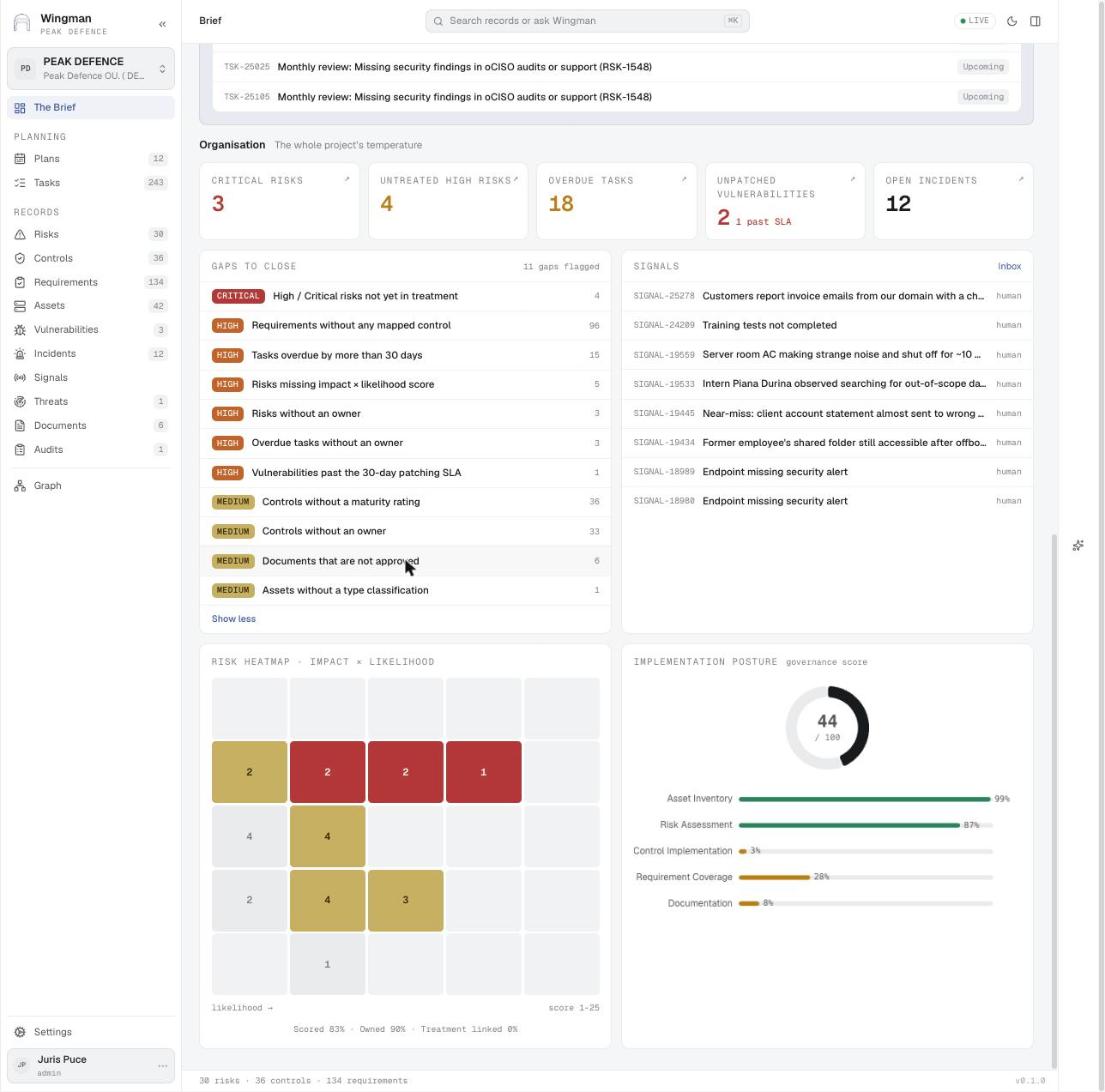
Register checks run across every record, not a sample: risks without an owner or a score, requirements without a control, controls without valid evidence, tasks more than 30 days late. Each gap links to the records behind it.
Nobody else could run this if I left.
Risks, controls, assets and plans are owned by roles. Assign the role to a successor and every record follows, with its tasks and evidence.
Reviews happen when I remember to chase them.
A plan generates the review tasks at its cadence, one per risk, asset or policy. Late ones are listed with the assignee's name, and reminders go out in your name after you approve them.
Scanner findings never reach the risk register.
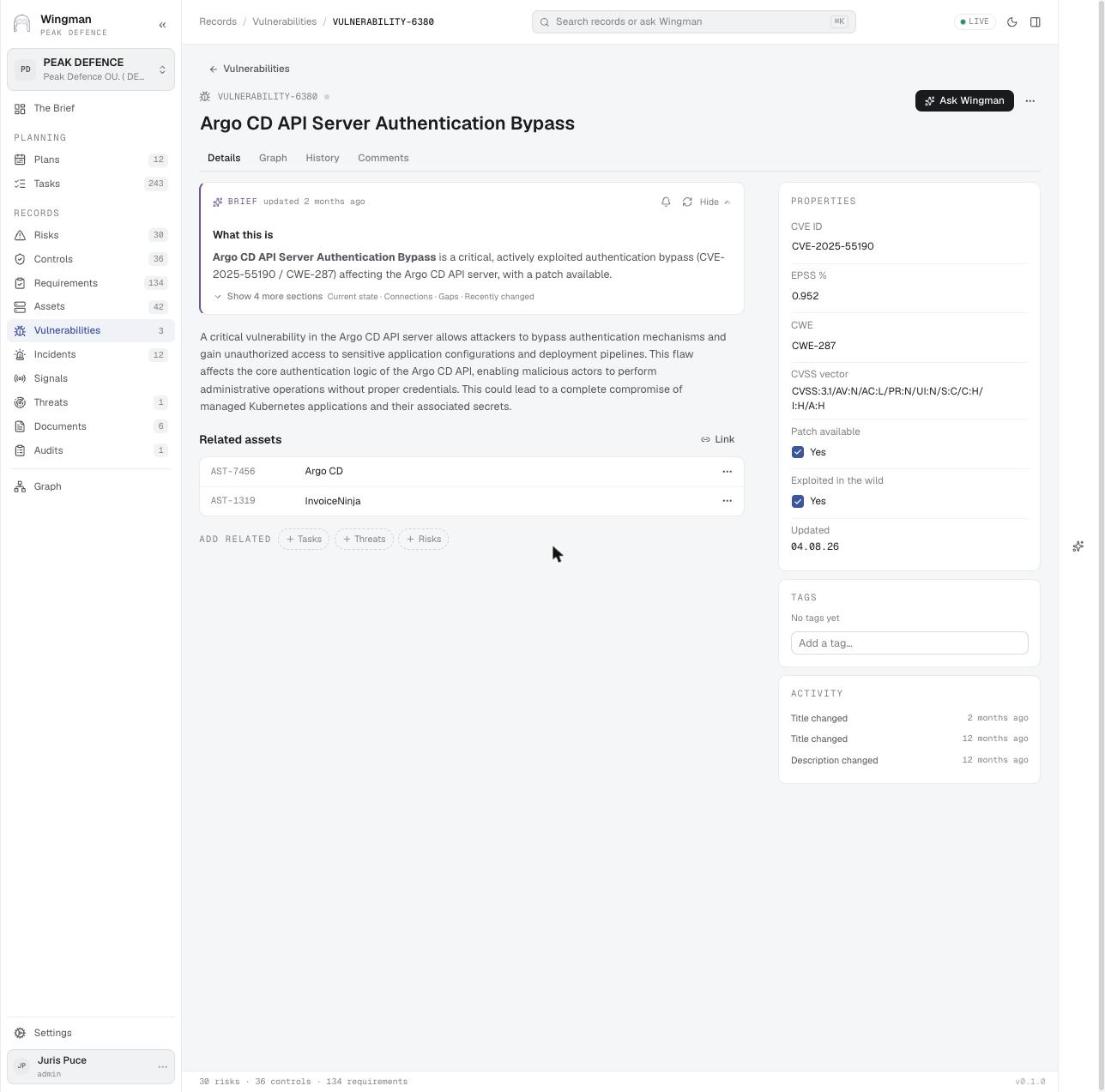
Vulnerabilities arrive from scanners and penetration-test tools with CVE, CVSS and EPSS, linked to the assets that carry them and the risks they raise. Remediation is ordered by the risk on critical assets, not by scanner severity alone.
Incidents happen, and the ratings stay as they were.
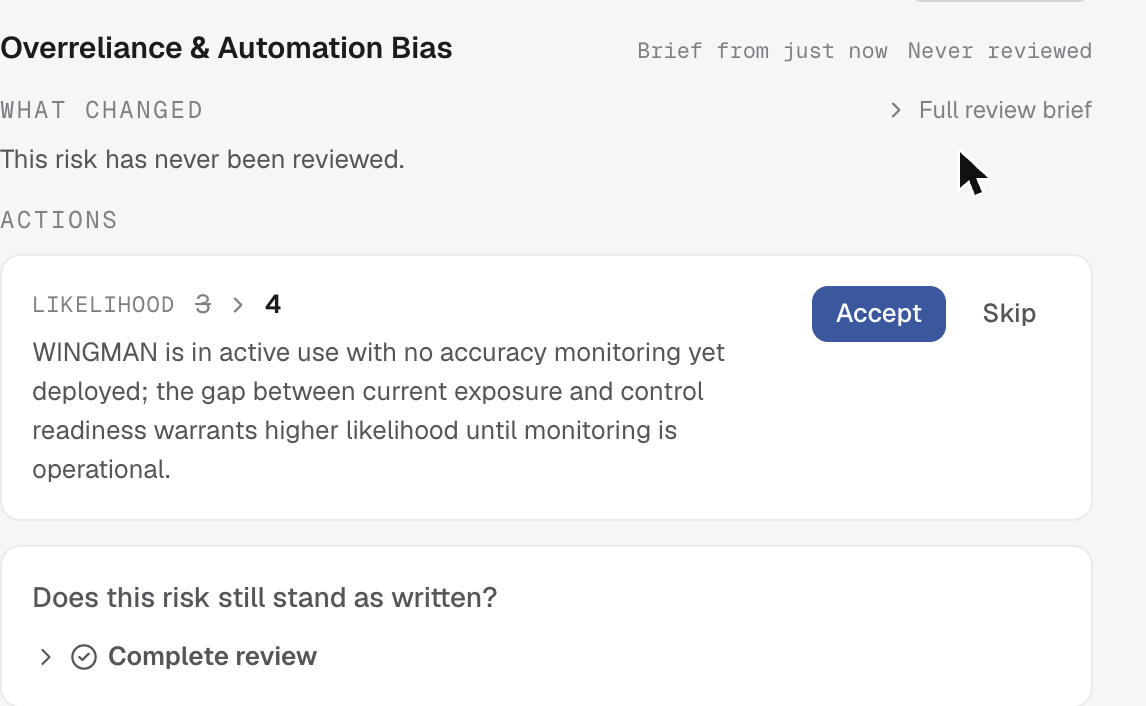
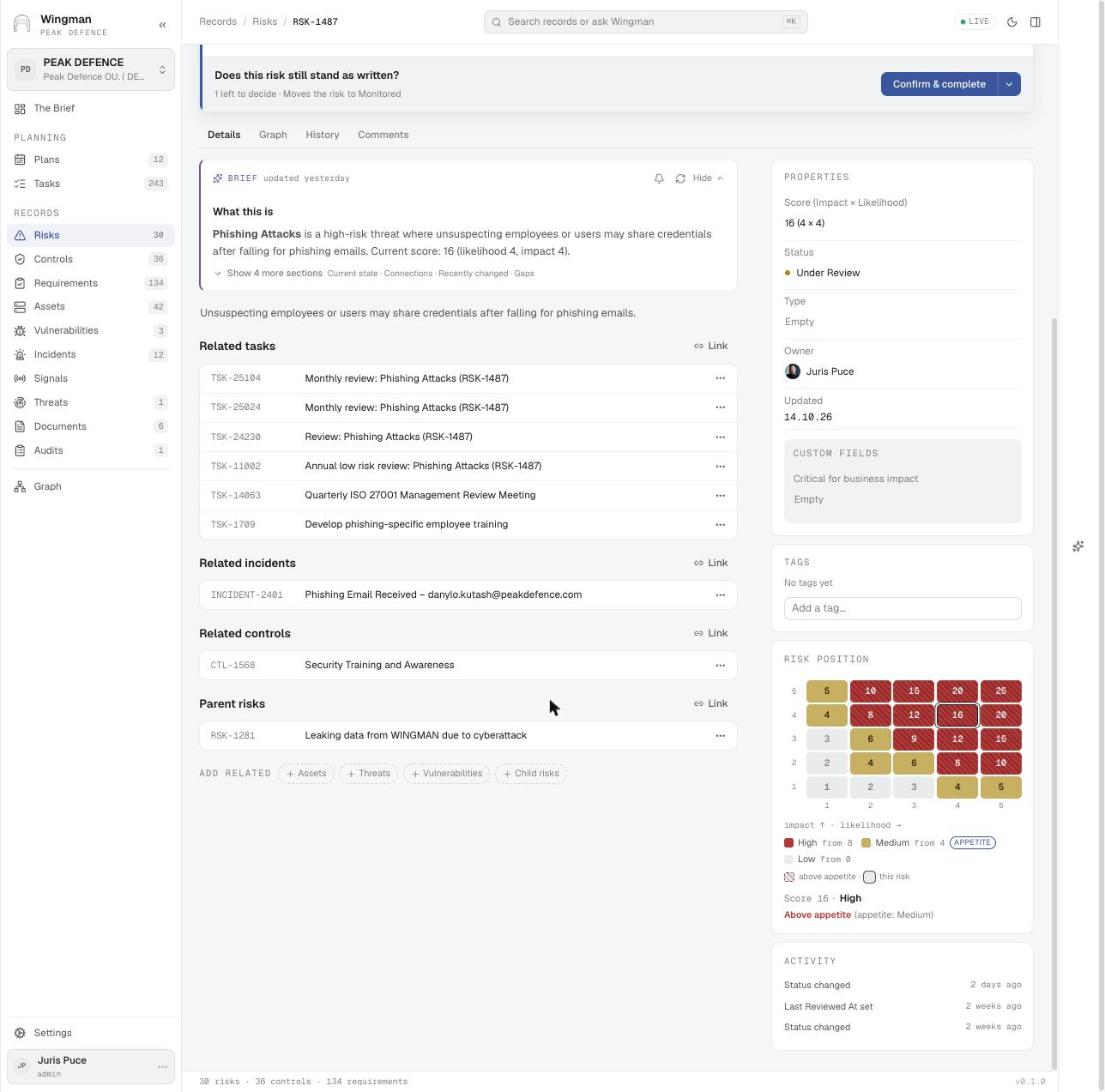
An incident is linked to the risk it made real. The next review of that risk opens with what changed since the last one and a proposed rating change with its reasoning.
My AI workflows start every chat from pasted context.
Assistants such as Claude and ChatGPT connect to WINGMAN over MCP and work on the record. A skill reads what is there, proposes changes and leaves the result for the next step, so you do not paste the register into a chat.
I can't let an agent write to the register unsupervised.
Changes arrive as suggestions with their reasons. A person accepts or skips each one, and nothing is written until the review is completed.
My suppliers live in a second sheet.
A supplier is a record linked to the services it provides, its contract and exit plan, its evaluation date and its risks. For financial entities this is the basis of the DORA register of information.
Words you will meet
- Skill
- A procedure your AI assistant follows step by step on your WINGMAN records, such as a risk interview or an audit. It runs in the assistant you already use, for example Claude.
- MCP
- An open standard that lets an AI assistant use tools and data. It is how Claude or ChatGPT connects to WINGMAN.
- Signal
- A sign that something is changing: a monitoring alert, a scanner result, a supplier's notice, threat news, or something a colleague reports.
- The Brief
- A short written summary of the state of the programme, produced by WINGMAN's AI every morning from the records.
- Register check
- A rule WINGMAN applies to every record to find gaps, such as a risk with no owner or a control with no valid evidence.
What WINGMAN does for you
-
1
Something happens
A new requirement, a review that is due, a scanner finding, an incident.
-
2
Your assistant prepares
It reads the linked record and drafts what should change: a risk rating, a report, a task.
-
3
A person decides
A named person accepts or rejects each suggestion. Nothing changes until then.
-
4
The record remembers
Who decided what, and when, stays in the history, which cannot be edited or deleted.
The next time something happens, the work starts from that record, not from a blank page.
The same four kinds of work as on the home page, from where you stand.
Keeps your security knowledge current
Every record exists once. A control links to the risks it reduces, the clauses it meets and the evidence that proves it, so the registers cannot drift apart. They can still be wrong, which is what the reviews are for. Your data can be exported.
Runs implementation and improvement projects
Select a framework and its requirements are loaded as records, or add single requirements such as a contract clause. Each is mapped to the controls you already have. One control can count for several standards; what is left is the gap.
Keeps routine work on schedule
Asset, risk, document, access and supplier reviews run on a calendar. Evidence carries an expiry date and is flagged before it lapses. The management review pack is assembled from the records.
Prepares the response to what was not planned
A scanner result, a supplier notice or threat news arrives as a signal. WINGMAN classifies it, shows what it touches and proposes a risk, an incident or tasks; the owner accepts or rejects.
What it looks like
Worked example
A quarterly management review pack
What the management body receives before a quarterly review, and what is recorded after it. Every line comes from a record that can be opened.
Worked example
One audit requirement, from claim to conclusion
How a single requirement is traced in an internal audit, from the document that claims the control to the conclusion, the correction and the check that the fix worked.
Worked example
One risk change, from signal to history
A vulnerability that is being exploited moves a risk rating. This sample shows the signal, the containment, the suggestion the AI raised, the person who accepted it, the treatment, and what the history keeps.
What stays with you
WINGMAN prepares, reminds and keeps the record. These remain with people.
- The risk decisions: ratings, treatments and acceptances are confirmed by the risk owner.
- The triage call. WINGMAN proposes a classification; a person decides.
- What goes out. Reports and reminders are drafted for you and sent after you approve them.
Try it in your own assistant first
It asks about your registers and your use of AI, then shows where the programme depends on memory and where registers can disagree. This prompt works in any capable AI assistant, without WINGMAN and without sending us anything. Leave out names and confidential details.
You are a peer reviewer for a security leader who runs an established security and compliance programme. Be direct. Answer in the language I write in.

Ask me the questions below one at a time and wait for each answer. Do not ask for company names or confidential details.
1. Which registers do you keep (risks, controls, assets, suppliers, evidence, incidents), and in which tools?
2. When did the risk register last change outside audit preparation, and what caused the change?
3. How does a scanner finding or a supplier's incident notice reach a risk rating today?
4. Which recurring reviews exist, and how do you know one was missed?
5. If you were away for three months, what could your deputy not do?
6. Where do you use AI assistants in this work, what do they read and write, and what does the assistant's provider retain?
7. How do you answer customer security questionnaires today?

Then give me:
- The places where the programme depends on one person's memory.
- The places where two registers can disagree, and how I would notice.
- The three events that should move a risk rating but currently do not.
- For each use of AI, what a person approves and where that approval is recorded.
- The three changes with the largest effect for the least work.
- Which board metrics I assemble by hand.
Present the gaps as a table I can paste into a spreadsheet. Do not recommend products.
Ask what this page does not answer
These are fair questions, and this page does not answer them yet. Tick the ones you want answered and the page writes the message. Send it with the contact form, or copy it. When you copy or send it, the site counts which of the listed questions were ticked; the text itself reaches us only when you send the form.
Where to look next
Operations
Day-to-day security management
Run security work through plans and tasks, with briefs, reminders and escalations, and ask "what needs to be done" against everything the model knows.
Operations
Regular reviews
Run the reviews good practice expects (assets, documents, risks, incidents, access) on a calendar instead of from memory.
Risk
Risk review and treatment
Review risks with all the context gathered since last time, plan their treatment, and keep several levels of risk consistent.
Risk
Vulnerability impact
Assess each vulnerability by the risk it raises, and fix first what matters most.
Operations
Supplier evaluation
Evaluate a supplier for feasibility before onboarding, and keep watching it afterwards.
ISO 27001 and SOC 2 Type 2
Keep the whole ISMS in one model, with control ownership, recurring reviews, management review and evidence that holds up over an audit period.
Financial sector – DORA, MiCA and supervisory expectations
Run operational, financial, reputational and other non-financial risk management on one model, and catch the events that should move it.
How it works
Data, hosting and AI
What is settled about where your records live, which AI works on them, who can reach them and what you can take with you, and what still has to be asked.
How it works
Works with your AI assistant
WINGMAN keeps the record, and the assistant you already use does the work on it. This page says how they connect, what the assistant can do, and what a skill is.
How it works
How AI is controlled
AI in WINGMAN proposes and a named person decides. This page says what that means in the records, who can change what, what history is kept, and what AI does not do.