Starting from zero
A customer asks for ISO 27001, and we have no security team
You do not need a security department to start. You need to know the order of the work, and one place where each result is kept so the next step builds on it. With the implementation skill, one person gets the plan, the risk register and the documents done in days instead of months.
Does this sound familiar?
The problem as people in this position describe it, and what changes with WINGMAN.
I don't know what to do first.
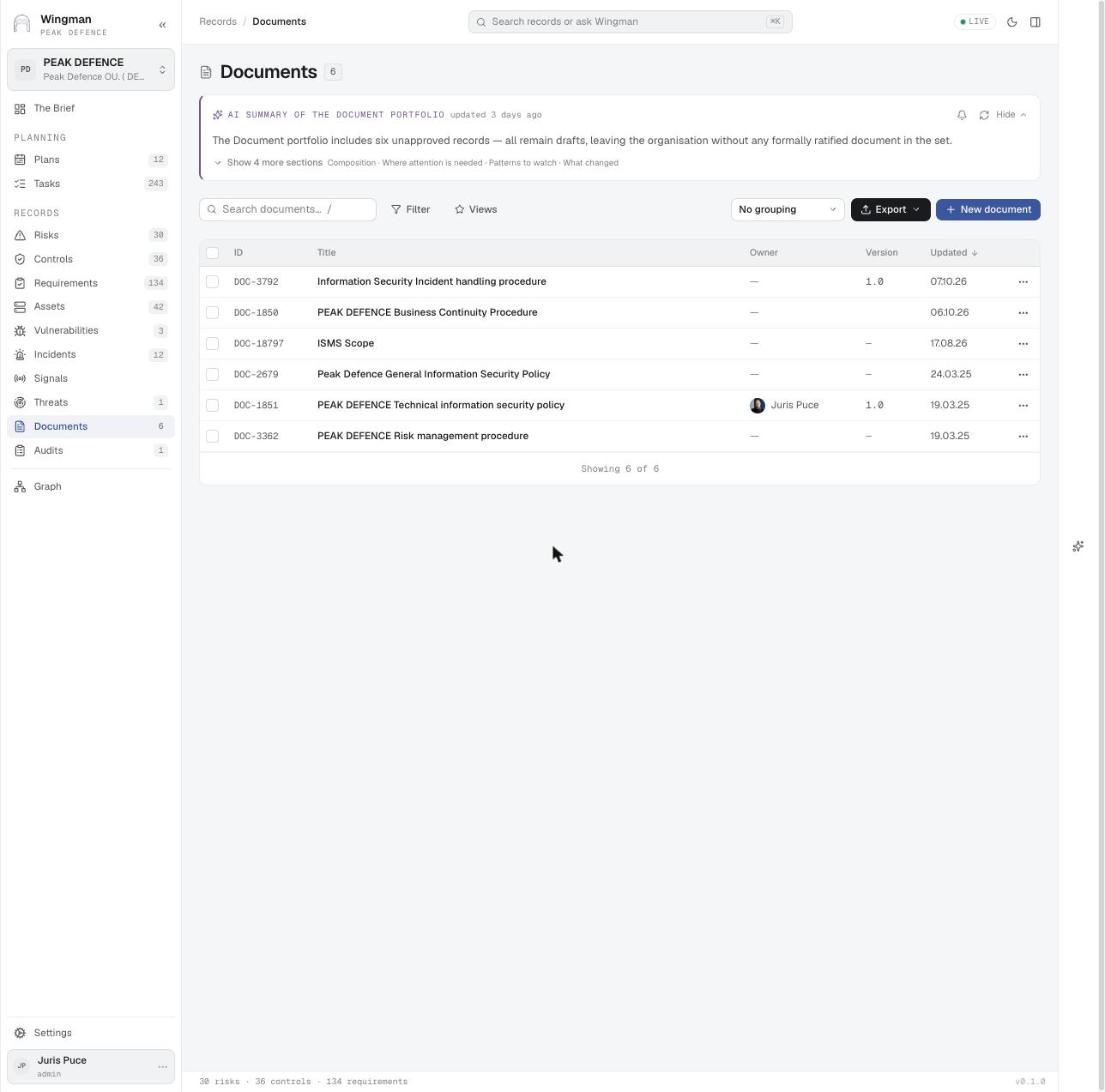
A skill is a procedure your AI assistant, for example Claude, follows step by step while connected to WINGMAN. The implementation skill works through fixed stages that you can stop and resume: your context, the requirements, the documents, a risk workshop (an interview about what could go wrong), the controls, and a roadmap that splits the tasks between the people who will do them. Each stage leaves records the next one uses, and the policies and procedures it drafts go out for approval and acknowledgement.
I don't know the vocabulary, and I'm embarrassed to ask.
The assistant asks one question at a time in plain words and explains a term when it needs one. The few you cannot avoid are listed below.
I'm afraid of ending up with a binder of policies nobody follows.
A policy is linked to the controls it describes, and a control needs evidence that it ran. A control with no valid evidence shows up as a gap, so paper without practice is visible to you before it is visible to an auditor.
It all lands on me, on top of my job.
The assistant drafts and you confirm. Recurring work, such as access reviews or supplier checks, becomes tasks for the people who run those systems, with reminders, so it is not all yours to remember.
My biggest customer sent a security questionnaire and a contract clause.
A customer's requirement is a record like any other. A contract clause is mapped to the control that meets it and to the matching clauses of the standard, so one control answers the customer and the auditor. This site does not show a tool that fills in a questionnaire for you.
Words you will meet
- ISMS
- Information security management system. It is what ISO 27001 certifies: how your company decides, carries out and checks its security, not a piece of software.
- Skill
- A procedure your AI assistant follows step by step on your WINGMAN records, such as a risk interview or an audit. It runs in the assistant you already use, for example Claude.
- Control
- Something you do to reduce a risk or meet a requirement, such as enforcing multi-factor login or reviewing admin accounts every quarter.
- Statement of Applicability
- The list of the standard's controls, saying which apply to you, why, and whether they are in place.
- Evidence
- Proof that a control actually ran: a record, a screenshot, a log export. It has a date and it expires.
- Role
- A responsibility separate from the person who holds it, such as risk owner or incident manager. One person can hold several roles.
What WINGMAN does for you
-
1
Something happens
A new requirement, a review that is due, a scanner finding, an incident.
-
2
Your assistant prepares
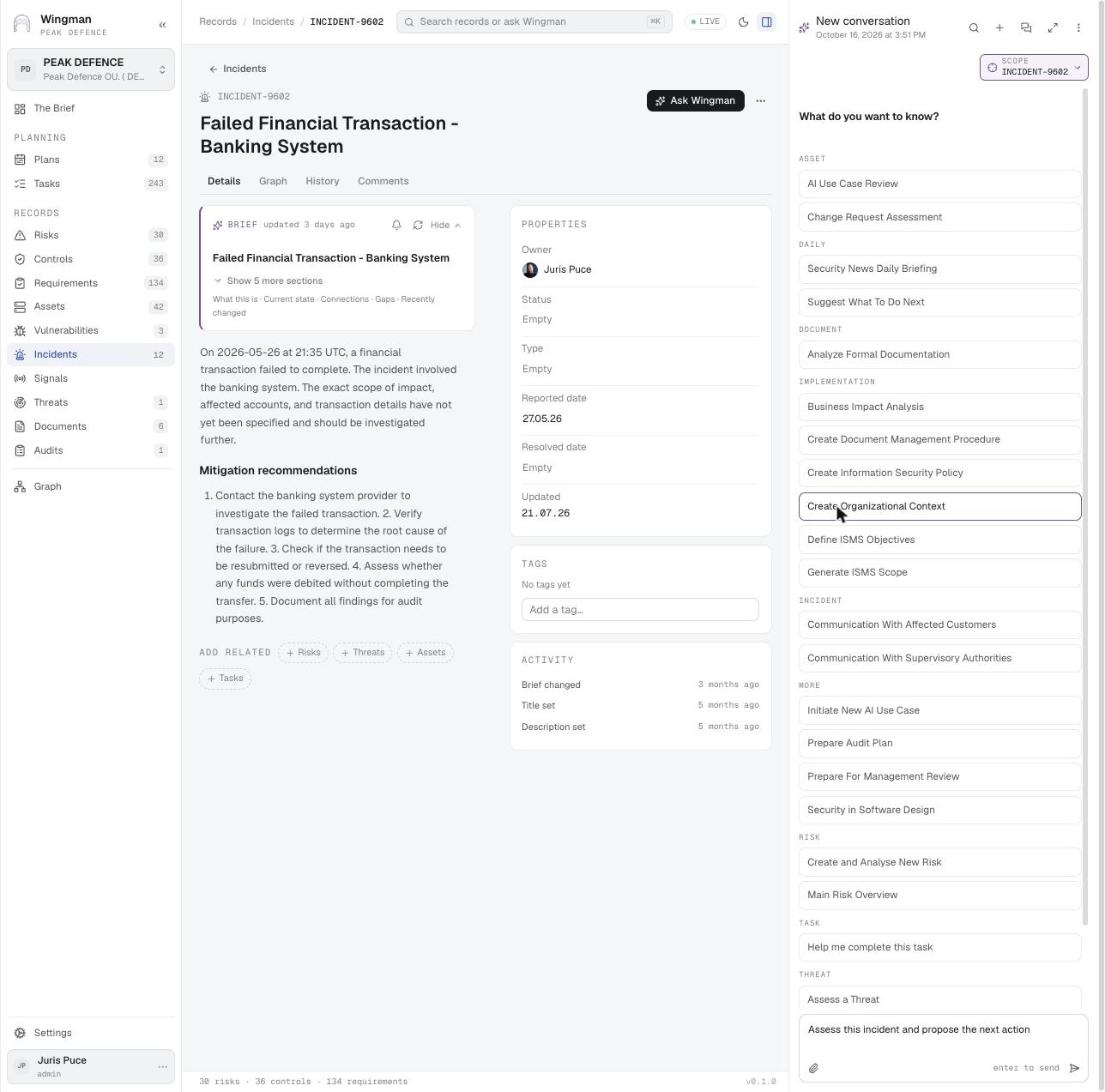
It reads the linked record and drafts what should change: a risk rating, a report, a task.
-
3
A person decides
A named person accepts or rejects each suggestion. Nothing changes until then.
-
4
The record remembers
Who decided what, and when, stays in the history, which cannot be edited or deleted.
The next time something happens, the work starts from that record, not from a blank page.
The same four kinds of work as on the home page, from where you stand.
Keeps your security knowledge current
Start from what you already run. Products, systems, data and suppliers become assets with owners; the scope statement is drafted from them.
Runs implementation and improvement projects
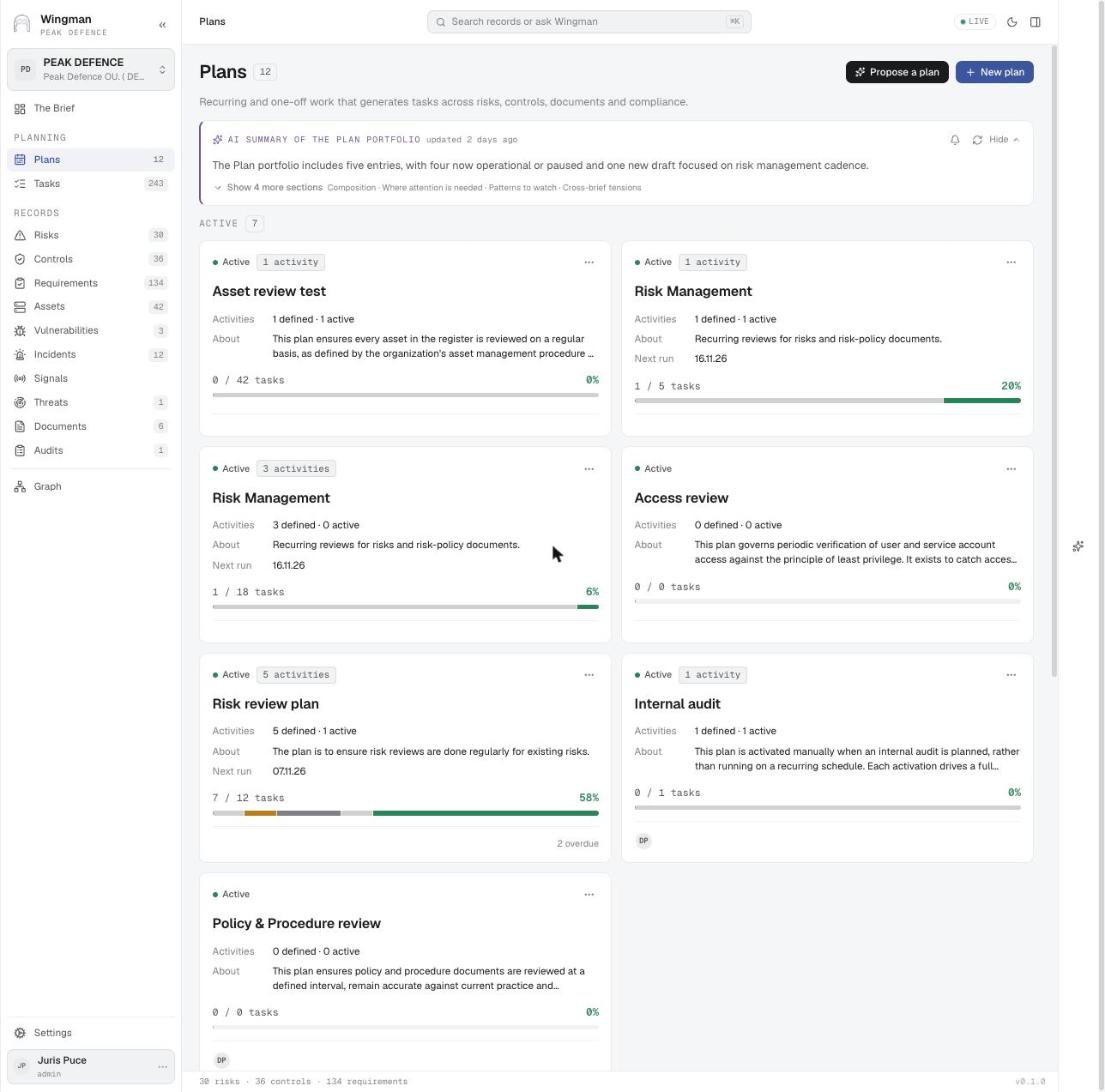
You select the framework, and its requirements are loaded as records. They are matched to what you already do, from what you tell the assistant and the documents you have. Each one is marked covered, partly covered or open; the open ones become controls to build, tasks and a plan. The implementation skill builds the plan in days: workstreams with owners, tasks with hours, and the policies and procedures, sent out for approval and acknowledgement.
Keeps routine work on schedule
A review calendar is built from the requirements that ask for reviews. Owners get their tasks and reminders; you see what is late and whose it is.
Prepares the response to what was not planned
Anyone can report something odd. Describe what happened in the chat and WINGMAN drafts the incident record as a suggestion for a person to accept.
What it looks like
What stays with you
WINGMAN prepares, reminds and keeps the record. These remain with people.
- The decisions. The assistant can draft a scope, a risk or a policy; someone who knows the company has to confirm that it is true.
- Running the controls. WINGMAN tracks that the backup test happened and keeps its evidence; it does not run the test.
- The certification audit. An accredited certification body does it, under a separate contract with you.
Try it in your own assistant first
It asks about your company and your customer's deadline, then gives you a scope, the work in order and the decisions only you can make. This prompt works in any capable AI assistant, without WINGMAN and without sending us anything. Leave out names and confidential details.
You are an experienced ISO 27001 implementer helping a technical founder with no security background. Use plain words and explain each term the first time you use it. Answer in the language I write in.

Ask me the questions below one at a time and wait for each answer. Do not ask for company names or confidential details.
1. What does the company build or run, and how many people work there?
2. Who asked for ISO 27001, and by when?
3. Where does the product run (which cloud, which main services), and how do people log in?
4. Which security practices already exist, even informally (access reviews, backups, code review, onboarding and offboarding)?
5. Which outside companies could take the product down or expose customer data if they failed?
6. Who could give a few hours a week to this, besides you?
7. If the customer sent a security questionnaire, paste three of its questions.

Then give me:
- A proposed scope in two sentences.
- The work in order, in six to eight steps, each with what it produces and who is needed.
- What I can reuse from what already exists.
- The five decisions only I can make.
- What a certification auditor will ask to see.
- Whether NIS2 is likely to apply to a company like this, and what to check.
Give ranges for the duration and for the internal hours a company of this size usually needs, and say what they depend on. Do not quote prices. Do not write policies yet.
Ask what this page does not answer
These are fair questions, and this page does not answer them yet. Tick the ones you want answered and the page writes the message. Send it with the contact form, or copy it. When you copy or send it, the site counts which of the listed questions were ticked; the text itself reaches us only when you send the form.
Where to look next
Compliance
New requirements
Implement a new regulation or standard by reusing and linking what already exists, then drive the rest with tasks and plans.
Risk
Risk identification
Find new risks without duplicates, link them to everything relevant, and let signals start identification or a re-review.
Operations
Regular reviews
Run the reviews good practice expects (assets, documents, risks, incidents, access) on a calendar instead of from memory.
Assurance
Auditing
Plan, run and close an internal or supplier audit on the records the organisation already keeps.
ISO 27001 and SOC 2 Type 2
Keep the whole ISMS in one model, with control ownership, recurring reviews, management review and evidence that holds up over an audit period.
NIS2 and national cybersecurity law
Run the information security office of an essential or important entity from one registry of suppliers, assets, risks, incidents, vulnerabilities, threats and tasks.
How it works
Data, hosting and AI
What is settled about where your records live, which AI works on them, who can reach them and what you can take with you, and what still has to be asked.
How it works
Works with your AI assistant
WINGMAN keeps the record, and the assistant you already use does the work on it. This page says how they connect, what the assistant can do, and what a skill is.
How it works
How AI is controlled
AI in WINGMAN proposes and a named person decides. This page says what that means in the records, who can change what, what history is kept, and what AI does not do.