For public bodies and one-person security functions
I look after security alone, next to another job
You are the cybersecurity manager, the incident manager and the risk coordinator, and you also have another job. WINGMAN keeps the registers the law expects and prepares the reports from them, so they are not written from nothing each time.
Does this sound familiar?
The problem as people in this position describe it, and what changes with WINGMAN.
The self-assessment report is written from nothing every time.
The report for NKDC is produced from the current records whenever it is due, so it rests on that day's data. For each requirement it lists the controls, their status and valid evidence and proposes an assessment with reasons. The assessment per requirement is kept, so the next report shows what changed.
Friday, 16:40. Is this incident significant?
The requirements of the regulation come loaded as records. WINGMAN proposes the classification against its criteria, with reasons, tracks the deadlines and drafts each report to CERT.LV from the incident record. You decide and you send.
The continuity plan was approved once and never tested.
A business impact analysis records, for each service, how long it can be down and what recovery it needs. Recovery tests are tasks with dates and their results are kept as evidence, so "when was this last tested" has an answer.
Nothing reminds me. I find out the access review was due in March.
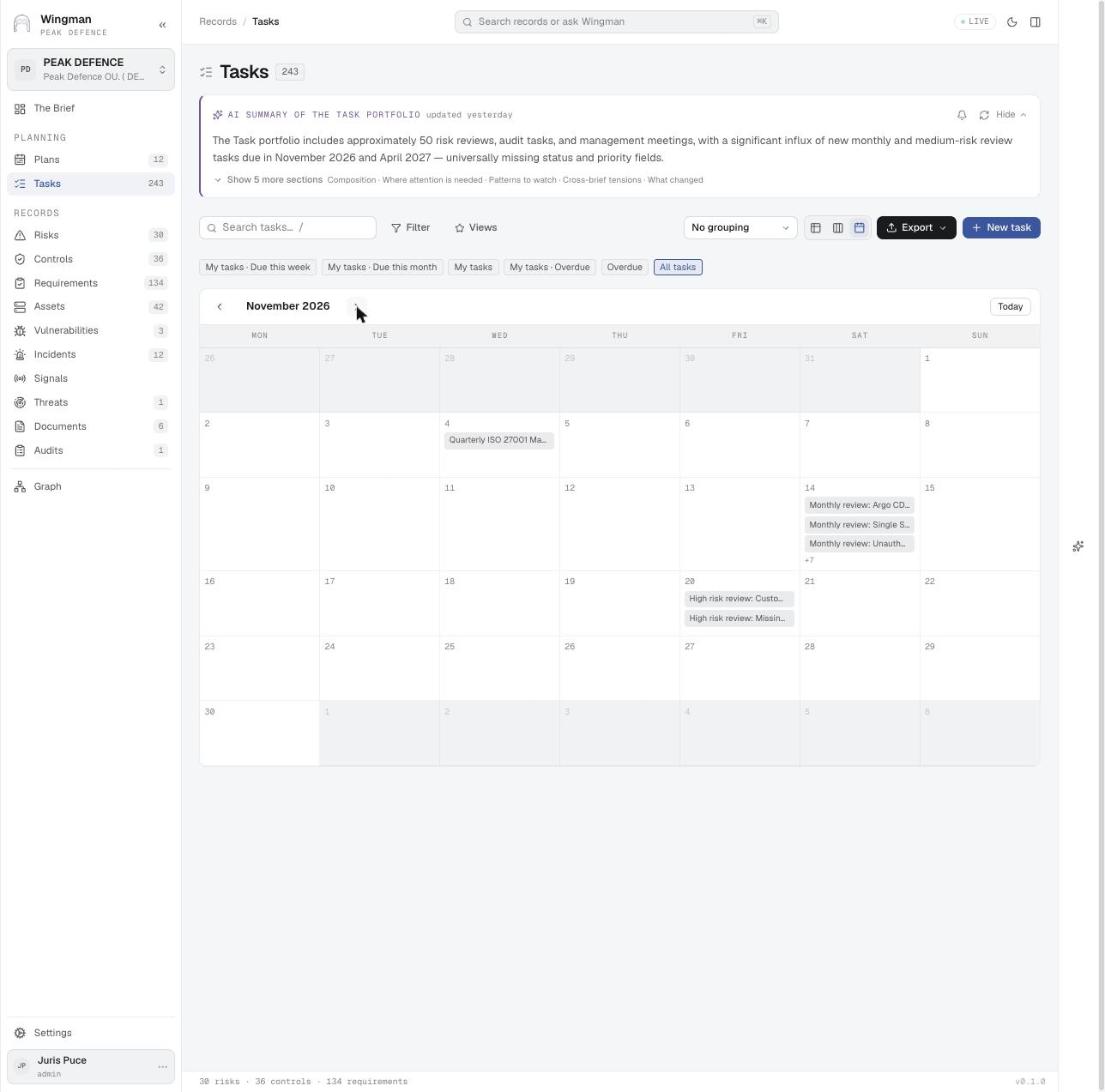
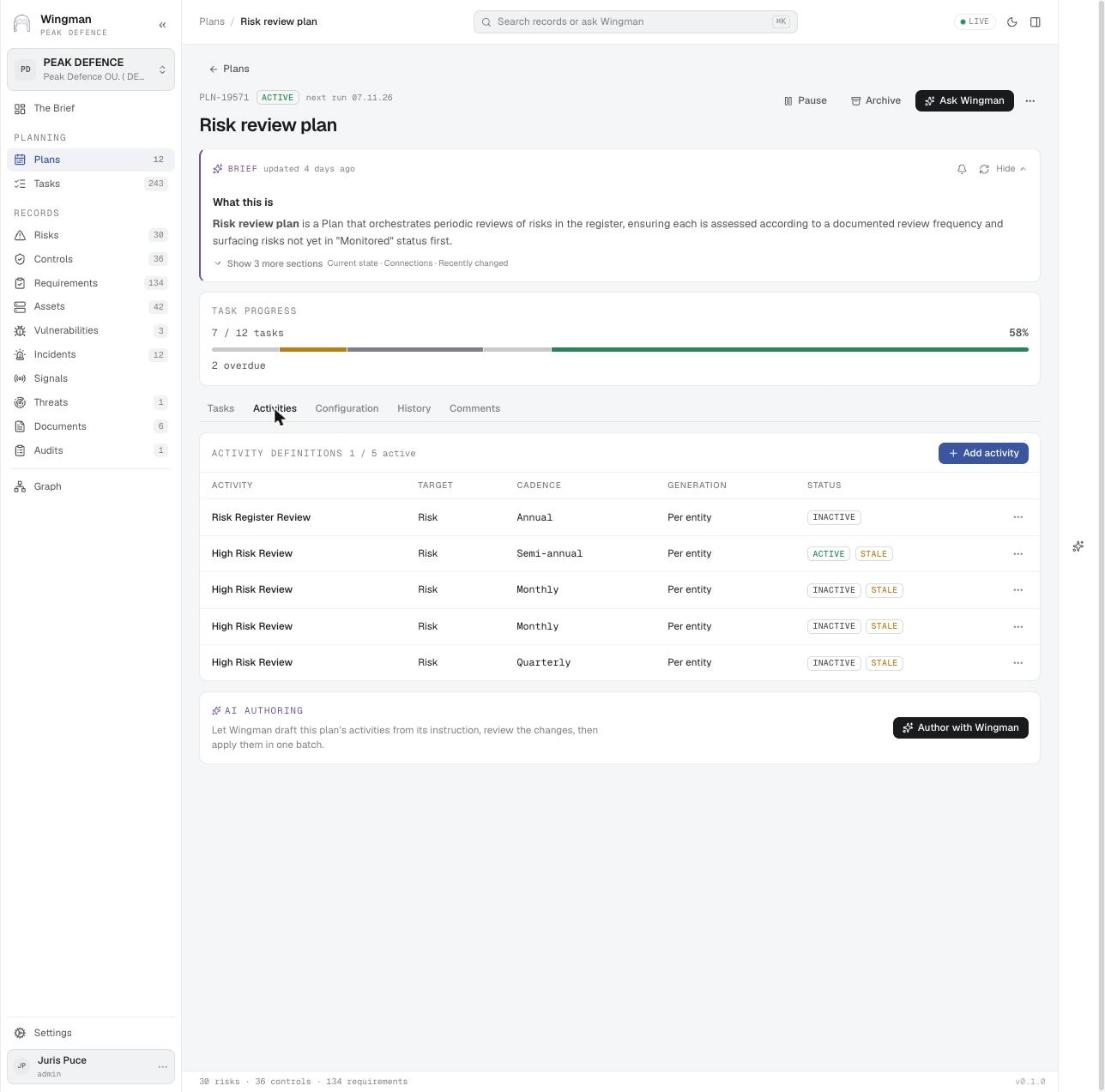
One plan holds every recurring review with its cadence. Tasks go to the owners of the systems, late ones are listed by name, and reminders go out in your name after you approve them.
Management gives me ten minutes at the end of a meeting.
The approval pack is prepared from the records, and the minutes are drafted from your notes. Decisions become tasks with owners, and unfinished ones are carried into the next review.
Every page talks about a CISO, an incident manager and a risk owner. That is all me.
Roles are separate from people, and one person can hold several. The record still shows which role decided, so the duties can be split later without rebuilding anything.
My suppliers are a contract list in Excel.
A supplier is a record linked to the services it provides, its contract, its evaluation date and the risks it is involved in. Once a supplier's incident notice is recorded as a signal, the links show which services it touches.
I am not sure we may put this data into a cloud AI service.
The model that writes briefs, suggestions and Ask Wingman answers is set up for your organisation: in the cloud, in a cloud restricted to the EU, or entirely in a local deployment, and Peak Defence can provide the model.
Words you will meet
- Signal
- A sign that something is changing: a monitoring alert, a scanner result, a supplier's notice, threat news, or something a colleague reports.
- Role
- A responsibility separate from the person who holds it, such as risk owner or incident manager. One person can hold several roles.
- Control
- Something you do to reduce a risk or meet a requirement, such as enforcing multi-factor login or reviewing admin accounts every quarter.
- Evidence
- Proof that a control actually ran: a record, a screenshot, a log export. It has a date and it expires.
What WINGMAN does for you
-
1
Something happens
A new requirement, a review that is due, a scanner finding, an incident.
-
2
Your assistant prepares
It reads the linked record and drafts what should change: a risk rating, a report, a task.
-
3
A person decides
A named person accepts or rejects each suggestion. Nothing changes until then.
-
4
The record remembers
Who decided what, and when, stays in the history, which cannot be edited or deleted.
The next time something happens, the work starts from that record, not from a blank page.
The same four kinds of work as on the home page, from where you stand.
Keeps your security knowledge current
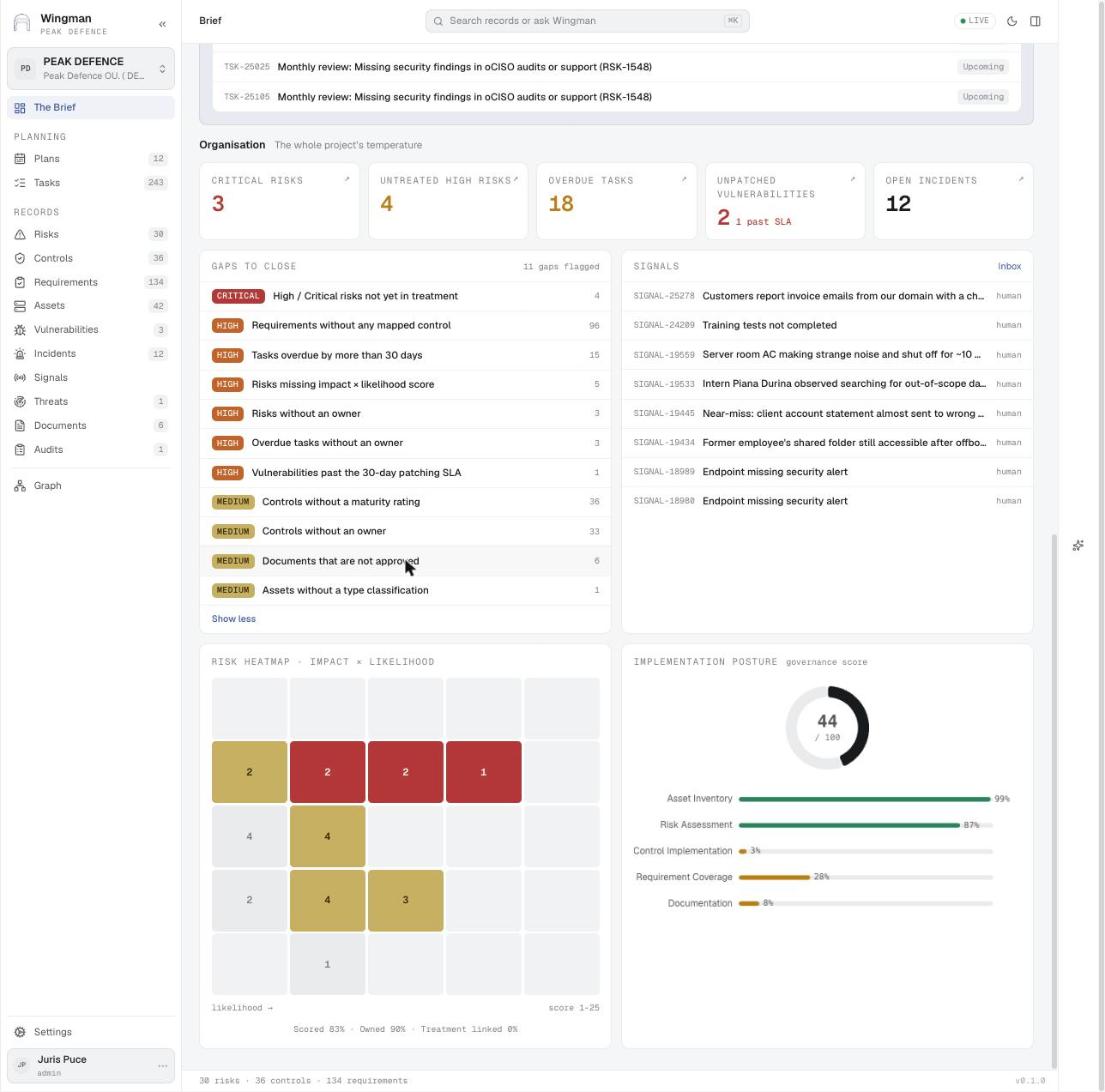
Services under the law, the systems and suppliers they depend on, risks, incidents and requirements are linked registers. The requirements come loaded when you select the framework; each one is a record linked to the controls in place.
Runs implementation and improvement projects
A risk interview or a business impact analysis runs one question at a time with the service owner. What they say becomes records they confirm.
Keeps routine work on schedule
Reviews follow a calendar. Evidence shows when it is about to expire. The self-assessment report and the management review are prepared from the records.
Prepares the response to what was not planned
Alerts, notices and reports arrive as signals. Each one is assessed and becomes an incident record when it needs to. A significant incident carries its reports and deadlines, and the incidents together form the cyber incident log.
What it looks like
Worked example
Self-assessment report: a structural example (Latvia)
The shape of the cybersecurity self-assessment report submitted to NKDC under the Latvian National Cybersecurity Law, produced from WINGMAN's records. Not NKDC's template.
Worked example
Reporting a significant incident to CERT.LV: a structural example
The shape of the reports for a significant incident, prepared from the incident record. Not the official template; deadlines to be checked against the national law.
What stays with you
WINGMAN prepares, reminds and keeps the record. These remain with people.
- Every decision and signature: the classification, the report, the acceptance of a risk.
- Interpreting the law. Check requirement texts and deadlines against the law and the regulation in force.
- Getting owners to answer. WINGMAN sends the task and the reminder; it cannot make a colleague reply.
Try it in your own assistant first
It asks about your duties and registers, then gives you what is missing and a twelve-month calendar sized for a few hours a week. This prompt works in any capable AI assistant, without WINGMAN and without sending us anything. Leave out names and confidential details.
You are helping a cybersecurity manager who works alone and can give security only part of their time, in an organisation covered by national NIS2 legislation. Answer in the language I write in.

Ask me the questions below one at a time and wait for each answer. My answers will be general. Do not ask for the organisation's name, system names, IP addresses, people's names or details of vulnerabilities.
1. What kind of organisation is it, how many people, and which law and regulation apply?
2. Which duties with dates do you know of (self-assessment, risk and continuity plan, incident reporting, audit)?
3. Which registers exist today, and in what form (services, systems, suppliers, risks, incidents)?
4. Which recurring checks should happen, and which actually happened in the last year?
5. Who on the management side is responsible, and when did they last decide something?
6. What would you do in the first hour of a suspected significant incident?

Then give me:
- A list of my duties as I described them, each with what exists and what is missing.
- A calendar for the next twelve months, month by month, sized for a few hours a week.
- What to ask of management, in one page.
- A first-hour checklist for an incident.
You do not know my national law. Do not state legal deadlines or criteria as facts; mark each one "check against the law" and tell me which document to check.
Ask what this page does not answer
These are fair questions, and this page does not answer them yet. Tick the ones you want answered and the page writes the message. Send it with the contact form, or copy it. When you copy or send it, the site counts which of the listed questions were ticked; the text itself reaches us only when you send the form.
Where to look next
Operations
Regular reviews
Run the reviews good practice expects (assets, documents, risks, incidents, access) on a calendar instead of from memory.
Operations
Incident handling
Support every stage of an incident, from the first signal to the risk review it should trigger.
Compliance
Management review
Prepare the ISO 27001 management review and NIS2 management body oversight with complete inputs, logged decisions and planned follow-up.
Risk
Business impact analysis
Assess how long each service can be down and what recovery it needs, from the services, risks and controls already recorded.
Operations
Supplier evaluation
Evaluate a supplier for feasibility before onboarding, and keep watching it afterwards.
NIS2 and national cybersecurity law
Run the information security office of an essential or important entity from one registry of suppliers, assets, risks, incidents, vulnerabilities, threats and tasks.
How it works
Data, hosting and AI
What is settled about where your records live, which AI works on them, who can reach them and what you can take with you, and what still has to be asked.
How it works
Works with your AI assistant
WINGMAN keeps the record, and the assistant you already use does the work on it. This page says how they connect, what the assistant can do, and what a skill is.
How it works
How AI is controlled
AI in WINGMAN proposes and a named person decides. This page says what that means in the records, who can change what, what history is kept, and what AI does not do.