For the board and CEO
I am accountable for security and cannot judge where we stand
NIS2 makes the management body approve the cybersecurity measures and oversee them. WINGMAN gives you a view you can read without a translator, and keeps the record of what you decided and when.
Does this sound familiar?
The problem as people in this position describe it, and what changes with WINGMAN.
I am personally accountable, and I could not show what I did about it.
The management review is a record: what was presented, what the management body decided, and when. Each decision becomes a task you can see finished. That is the trace of your oversight. The history of every record keeps who changed what and when, and it cannot be edited or deleted.
I sign what arrives the day before the meeting.
The management review is a recurring item with a date and an accountable role. Its pack is assembled from the records: earlier actions, audit results, risk changes, incidents and supplier performance. It does not depend on someone compiling slides the night before.
I see security once a year, in a slide deck I do not understand.
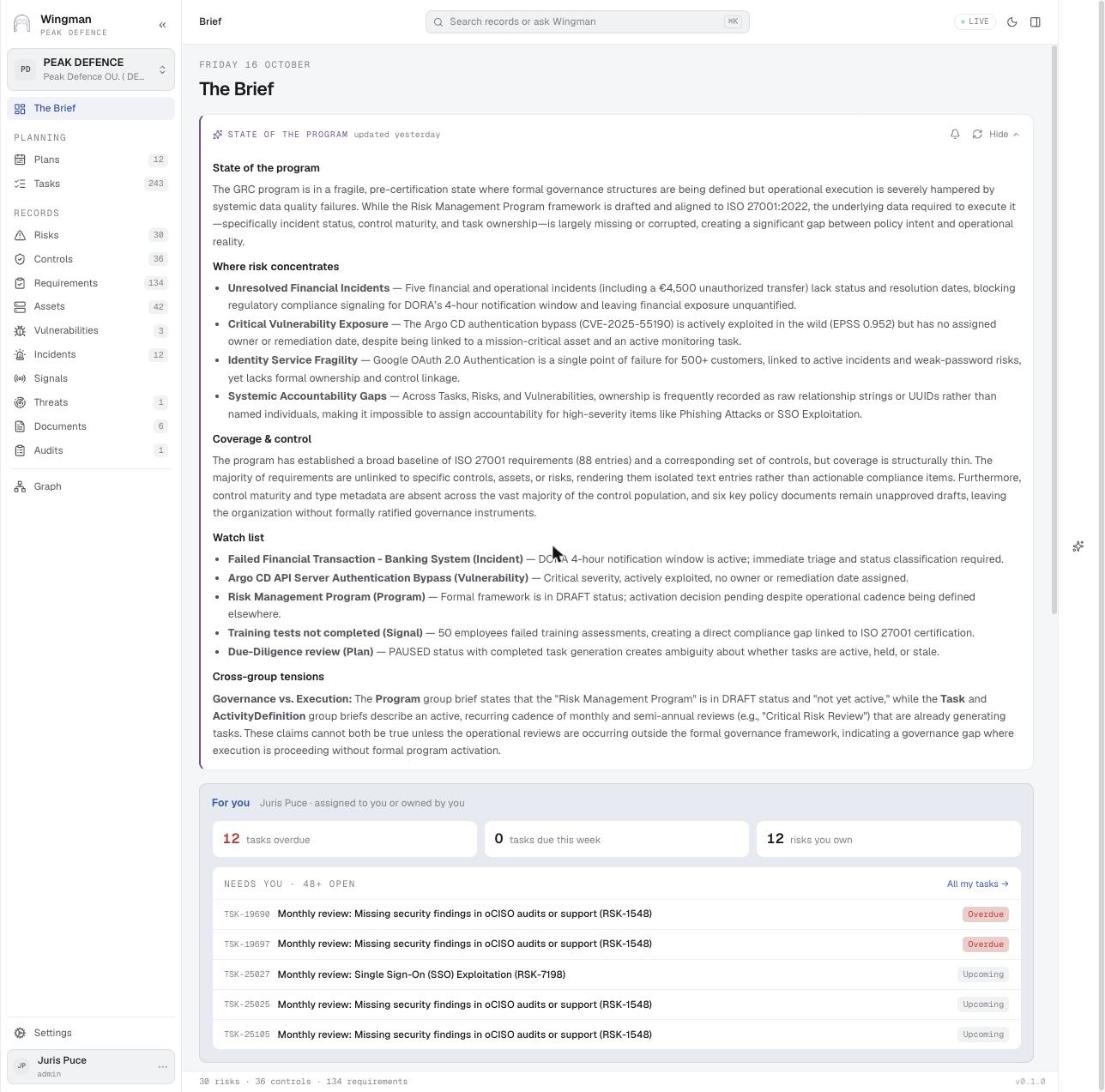
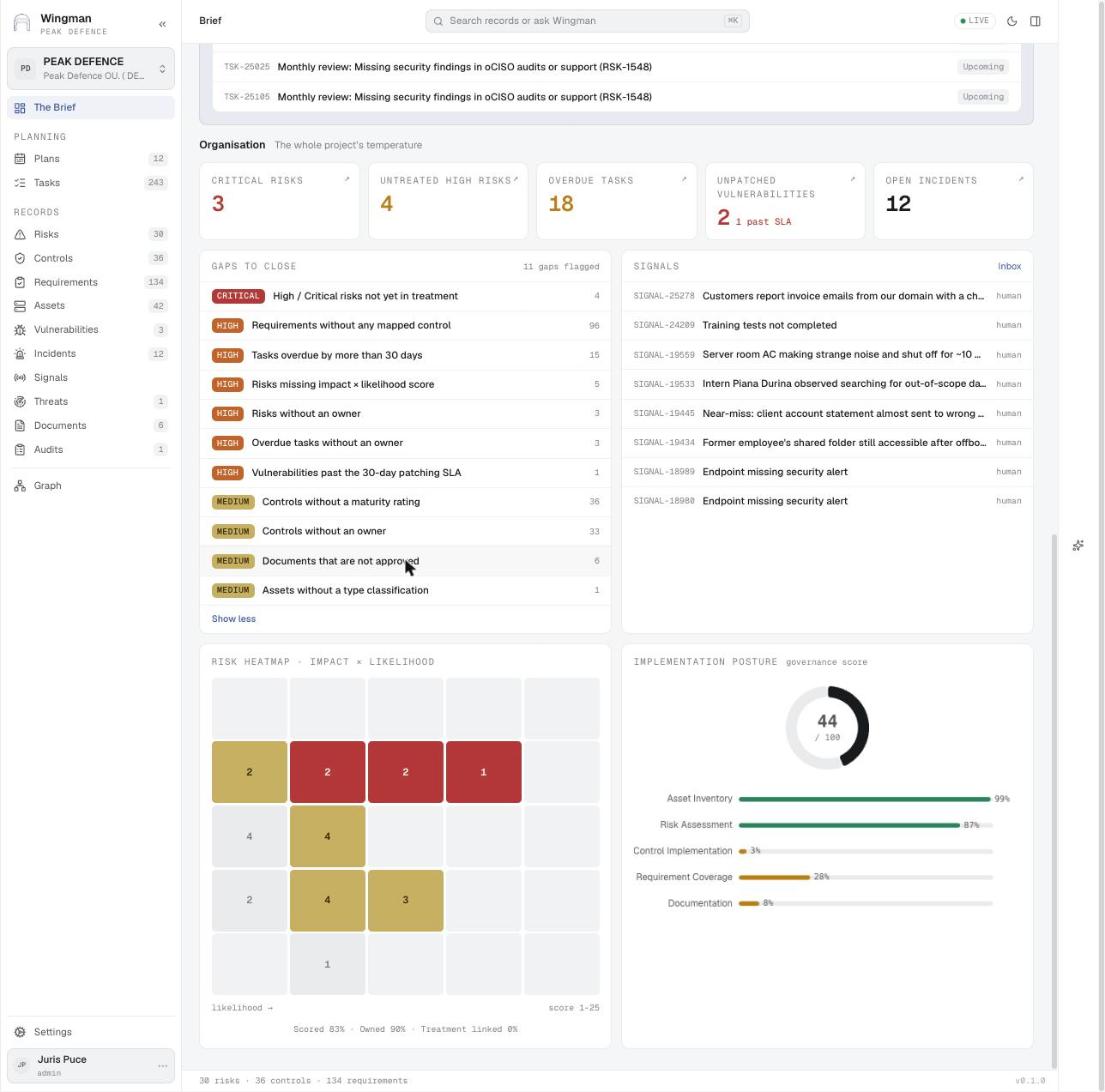
The Brief is a short summary that WINGMAN's AI writes every morning from the records, in sentences: where risk concentrates, what is covered, what to watch. The gaps it lists link to the records behind them, so your security lead can check it and you can ask about any line.
My IT manager says we are fine. I cannot check.
Gaps are listed by name: risks with no owner, legal requirements nothing is done about, tasks more than 30 days late, documents nobody approved. Each one links to the record and the person responsible. The list is as good as the records, which the routine reviews keep current.
If our one security person leaves, it all leaves with them.
Records belong to roles, not to people. Assign the role to a successor and the risks, controls and tasks follow.
What happens when something goes wrong?
The incident record shows how severe it is, which reports are due and by when (under NIS2, an early warning in 24 hours and a notification in 72), and who leads. WINGMAN drafts the reports; a named person approves and sends them.
Words you will meet
- The Brief
- A short written summary of the state of the programme, produced by WINGMAN's AI every morning from the records.
- Management review
- The regular meeting where management looks at the state of security and decides what to do. Its minutes are kept as a record.
- Control
- Something you do to reduce a risk or meet a requirement, such as enforcing multi-factor login or reviewing admin accounts every quarter.
- Role
- A responsibility separate from the person who holds it, such as risk owner or incident manager. One person can hold several roles.
What WINGMAN does for you
-
1
Something happens
A new requirement, a review that is due, a scanner finding, an incident.
-
2
Your assistant prepares
It reads the linked record and drafts what should change: a risk rating, a report, a task.
-
3
A person decides
A named person accepts or rejects each suggestion. Nothing changes until then.
-
4
The record remembers
Who decided what, and when, stays in the history, which cannot be edited or deleted.
The next time something happens, the work starts from that record, not from a blank page.
The same four kinds of work as on the home page, from where you stand.
Keeps your security knowledge current
You read a summary written from the same records your security people work on, and its gaps lead to the record behind them.
Runs implementation and improvement projects
When a new law or standard applies, the work becomes a plan with an accountable role, tasks and dates. You can follow its progress without asking.
Keeps routine work on schedule
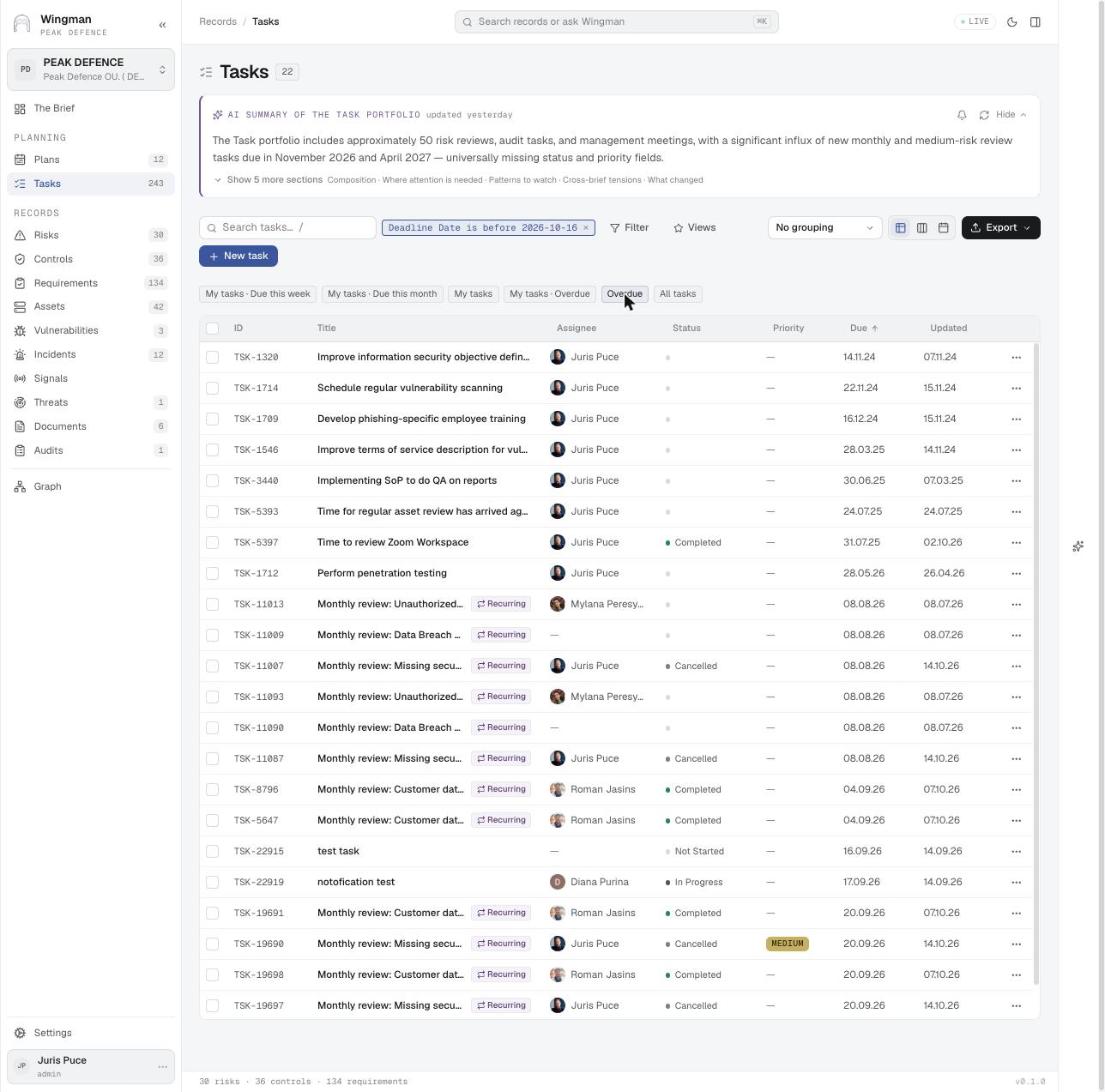
The management review comes round at the interval you set (quarterly in our example). Decisions are recorded in the minutes, each becomes a task with an owner, and unfinished ones return at the next review.
Prepares the response to what was not planned
An incident carries its deadlines, its draft reports and the follow-up tasks. Afterwards the record shows what was done and when.
What it looks like
What stays with you
WINGMAN prepares, reminds and keeps the record. These remain with people.
- Approving the measures and the minutes. WINGMAN prepares the pack and drafts the minutes; the management body approves.
- Deciding which risks to accept and what to fund.
- Your own training. WINGMAN records who was trained and who acknowledged a policy; it does not provide the course.
Try it in your own assistant first
It asks you seven questions, one at a time, then tells you where you stand, which decisions to ask for and what you should be able to show. This prompt works in any capable AI assistant, without WINGMAN and without sending us anything. Leave out names and confidential details.
You are advising a non-technical chief executive or board member who is accountable for cybersecurity (for example under NIS2 or DORA). Answer in the language I write in.

Ask me the questions below one at a time and wait for each answer. Do not ask for company names or confidential details.
1. What does the organisation do, how many people work there, and which law or customer makes security your responsibility?
2. Who looks after security day to day, and is it their only job?
3. When did management last formally review security, and what was decided?
4. Which security documents, if any, have you personally approved in the past year?
5. If a serious incident started tonight, who would be called, and who decides whether an authority must be told?
6. How would you know today whether the agreed measures are actually carried out?
7. What happens if the person from question 2 leaves?

Then give me:
- Where I stand, in five plain sentences.
- Three decisions I should ask for at the next management meeting.
- Five questions to put to the person who looks after security.
- What I should be able to show if someone asked how I oversaw security.
- How many hours a quarter I should expect to spend on this, and what that depends on.
Say clearly where the answer depends on national law that I should check. Do not invent legal requirements.
Keep the whole answer to one page.
Ask what this page does not answer
These are fair questions, and this page does not answer them yet. Tick the ones you want answered and the page writes the message. Send it with the contact form, or copy it. When you copy or send it, the site counts which of the listed questions were ticked; the text itself reaches us only when you send the form.
Where to look next
Compliance
Management review
Prepare the ISO 27001 management review and NIS2 management body oversight with complete inputs, logged decisions and planned follow-up.
Accountability
Roles and RACI
Make responsibilities explicit, and find gaps in coverage and conflicts in segregation of duties.
Operations
Incident handling
Support every stage of an incident, from the first signal to the risk review it should trigger.
NIS2 and national cybersecurity law
Run the information security office of an essential or important entity from one registry of suppliers, assets, risks, incidents, vulnerabilities, threats and tasks.
Financial sector – DORA, MiCA and supervisory expectations
Run operational, financial, reputational and other non-financial risk management on one model, and catch the events that should move it.
How it works
Data, hosting and AI
What is settled about where your records live, which AI works on them, who can reach them and what you can take with you, and what still has to be asked.
How it works
Works with your AI assistant
WINGMAN keeps the record, and the assistant you already use does the work on it. This page says how they connect, what the assistant can do, and what a skill is.
How it works
How AI is controlled
AI in WINGMAN proposes and a named person decides. This page says what that means in the records, who can change what, what history is kept, and what AI does not do.